
Landscape lighting subcontracting is the practice of hiring a specialized lighting contractor to handle outdoor lighting design and installation on behalf of a general contractor, landscaper, or builder. Rather than managing lighting work in-house, the primary contractor delegates that scope to a lighting expert. This arrangement is common in residential construction, commercial landscape lighting services, and high-end renovation projects where technical precision matters. Understanding what landscape lighting subcontracting involves, and how to manage it well, directly affects your project quality, timeline, and profit margin.
What is landscape lighting subcontracting, exactly?
Landscape lighting subcontracting is a formal trade arrangement. A general contractor or landscaper, called the prime contractor, hires a lighting specialist, the subcontractor, to complete the lighting scope of a larger project. The prime contractor remains responsible to the client, while the sub delivers the technical work.
The key stakeholders in this arrangement include general contractors, custom home builders, landscape architects, and smart home integrators. Each brings a different reason for subcontracting outdoor lighting. Builders want to stay on schedule. Landscapers want to offer a complete package without hiring in-house electricians. Integrators want lighting tied into control systems without managing field crews.
Specialized lighting subcontractors handle fixture placement, wiring, transformer sizing, and control integration. These are tasks that general landscapers or builders often lack the depth to execute at a professional level. The difference between a contractor and a subcontractor here is simple: the contractor owns the client relationship, and the sub owns the technical execution.

What skills do landscape lighting subcontractors bring?
Lighting subcontractors provide expertise that goes well beyond screwing in a fixture and running wire. Their value sits in three specific technical areas: system design, electrical engineering, and fixture knowledge.
System design means understanding how light interacts with architecture, plant material, and hardscape. A skilled sub knows where to place uplights on a tree to avoid flat, washed-out results. They understand beam angles, color temperature, and how shadows create depth.
Electrical engineering at the low-voltage level is more demanding than it looks. Proper transformer sizing to approximately 80% of rated capacity and following NEC Article 411 is standard best practice for professional installations. Voltage drop across long wire runs is the most common failure point in amateur installs. A professional sub calculates this before a single fixture goes in the ground.
Key technical skills a qualified lighting sub brings to any project:
- Fixture selection matched to property features and client budget
- Voltage and wire gauge calculations to prevent voltage drop
- Transformer load sizing per NEC guidelines
- Smart home integration with platforms like Lutron, Control4, or Josh.ai
- Conduit routing and sleeve placement during rough-in phases
Pro Tip: Ask any lighting sub candidate to walk you through their voltage drop calculation method before you hire them. If they cannot explain it clearly, their installs will show it.
A typical landscape lighting installation involves site review, wire routing, fixture mounting, transformer programming, and a client walkthrough, often completed within a single day for standard residential projects. Complex rooflines or large commercial properties extend that to two days. Knowing this helps you schedule the sub accurately within your broader project timeline.
Subcontracting vs. in-house lighting: pros and cons
The decision to subcontract outdoor lighting or build that capability in-house is a real business tradeoff. Neither answer is always right. The right choice depends on your project volume, crew skills, and how much control you need over the client experience.
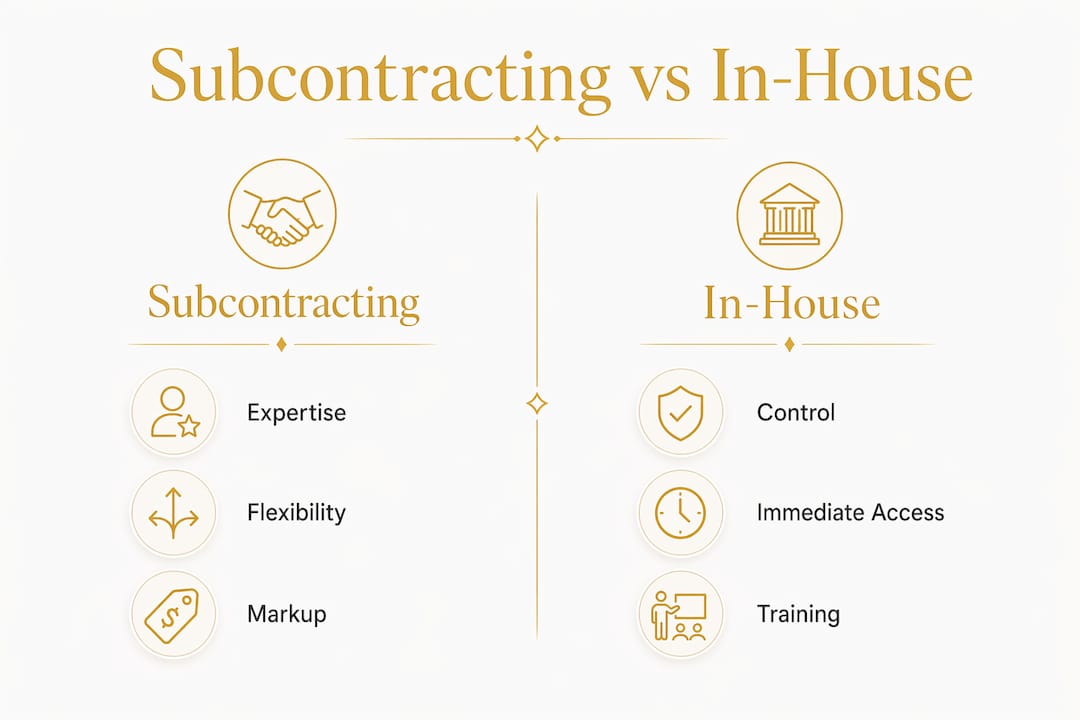
| Factor | Subcontracting | In-House |
|---|---|---|
| Technical expertise | High, specialized knowledge | Depends on crew training |
| Profit margin | Lower, 15–25% markup passed through | Higher, full margin retained |
| Project scope | Expands without hiring | Limited to existing skills |
| Schedule control | Dependent on sub availability | Fully controlled |
| Smart home integration | Risk of fragmented systems | Consistent platform control |
| Warranty responsibility | Split between prime and sub | Single point of accountability |
Integrators who outsource landscape lighting risk fragmented systems that sit outside the main control platform. That fragmentation hurts the client experience and creates service headaches down the road. For smart home integrators specifically, this is a serious consideration.
Markup ranges for electrical subcontracting typically run 15–25%, influenced by coordination complexity and inspection requirements. That margin comes directly off your project profit. For a $20,000 lighting scope, you could be leaving $3,000 to $5,000 on the table.
Pro Tip: If you subcontract lighting regularly, negotiate a preferred vendor rate with one or two reliable subs. Volume loyalty often earns you better pricing and scheduling priority.
The benefits of landscape lighting subcontracting are real: you get expert results without training your crew, you can take on larger projects, and you reduce your liability on technical electrical work. The tradeoffs are equally real: you give up margin, schedule flexibility, and direct quality control.
How do you coordinate lighting subs within a larger project?
Coordination is where most subcontracting arrangements succeed or fail. The single biggest mistake builders and landscapers make is bringing the lighting sub in too late. By the time concrete is poured and sod is laid, your options for clean wire routing are gone.
Follow this sequence to keep lighting subcontracting on track:
- Engage the lighting sub during design. Have them review plans before permits are pulled. They will identify conduit routes, transformer locations, and control panel placement that must be decided early.
- Pre-route conduit and sleeves during rough-in. Trenches and sleeves installed before hardscapes prevent damage to finished surfaces and keep project schedules intact. This is the single highest-value coordination step.
- Coordinate transformer and panel placement with the electrician. The lighting sub needs a dedicated circuit in the right location. Confirm this with your electrical sub before rough-in inspection.
- Schedule fixture installation after hardscape and before final turf. This is the window where the sub can work freely without damaging finished surfaces or fighting through established plant material.
- Build a client walkthrough into the schedule. The sub should program and demonstrate the system with the client present. This protects you from callbacks and sets expectations correctly.
Missing lighting infrastructure during construction leads to costly retrofits and schedule disruption. Saw cuts through finished concrete or pavers can cost more than the original lighting scope. Early pre-wiring eliminates this risk entirely.
Pro Tip: Add a line item to your project checklist: "Lighting sleeve drawing reviewed before slab pour." One missed sleeve can cost more to fix than the sub's entire fee.
The coordination burden falls on the prime contractor. Your lighting sub cannot protect you from scheduling mistakes you make. Build lighting coordination checkpoints into your project management software, whether you use Buildertrend, CoConstruct, or a simple spreadsheet.
How do you hire and manage lighting subs for profit and quality?
Hiring the right lighting subcontractor starts with a structured bid process. Get at least three bids for any project over $10,000 in lighting scope. Compare them on fixture specifications, not just total price. A low bid that uses inferior fixtures will cost you in warranty callbacks.
Tracking subcontractor bids and historical pricing improves profitability and helps you make informed decisions about which trades to subcontract. Build a simple pricing database. After three or four projects with the same sub, you will know what their numbers should look like and spot inflated bids immediately.
Key practices for managing lighting subs profitably:
- Require a written scope of work that specifies fixture models, wire gauge, transformer brand, and warranty terms before signing any contract.
- Clarify permit responsibility in writing. Electrical subs must be accountable for pulling permits and securing inspection certificates to avoid project closeout delays.
- Track change orders aggressively. Lighting subs often add scope through change orders. Approve nothing verbally. Every change needs a written cost and schedule impact before work proceeds.
- Confirm insurance and licensing. Your liability exposure is real if an unlicensed sub does electrical work on your project.
- Build warranty terms into the subcontract. Specify who handles fixture failures, wiring faults, and transformer issues for at least one year post-installation.
Hardwired systems or projects requiring trenching frequently trigger permitting requirements. Plug-in low-voltage kits using existing GFCI receptacles often do not. Know which category your project falls into before the sub starts work, because a missed permit can halt your entire project at final inspection.
Accurate cost control in subcontracted lighting projects requires explicit estimating of fixture installation times, wire runs, and transformer sizing. Vague scopes produce change orders. Detailed scopes protect your margin.
Key takeaways
Effective landscape lighting subcontracting requires early coordination, detailed contracts, and disciplined cost tracking to protect project quality and profit margins.
| Point | Details |
|---|---|
| Define the sub's scope early | Engage lighting subs during design to avoid costly rework after hardscapes are finished. |
| Track bids and markups | Electrical subcontracting markups run 15–25%; historical bid data helps you spot inflated pricing fast. |
| Clarify permit responsibility | Assign permit and inspection duties to the electrical sub in writing before work begins. |
| Protect margin with detail | Vague scopes generate change orders; specify fixture models, wire gauge, and transformer brand upfront. |
| Weigh in-house vs. subcontract | Subcontracting expands project scope but reduces margin; the right choice depends on your volume and crew skills. |
What i've learned after years of watching lighting subs win and lose projects
The contractors who get the most value from lighting subcontracting are not the ones who find the cheapest sub. They are the ones who treat the lighting sub like a design partner from day one, not a vendor they call when the project is 80% done.
I have watched builders bring a lighting sub in after the driveway pavers were sealed. The result was a saw cut through $15,000 worth of travertine to run a single conduit. That mistake cost more than the lighting system itself. The builder blamed the sub. The sub blamed the builder. The client paid for both.
The uncomfortable truth about subcontracting outdoor lighting is that the prime contractor carries the coordination risk. Your sub can do flawless technical work and still create a disaster if you hand them a project with no pre-routed conduit and a two-week window before final inspection.
Smart home integration adds another layer of complexity that most builders underestimate. A lighting system that runs on its own app, separate from the client's Control4 or Lutron setup, is a client satisfaction problem waiting to happen. Specify integration requirements before you hire the sub, not after the transformer is programmed.
Subcontracting lighting is a legitimate and often smart business decision. Just go in with clear contracts, early engagement, and a realistic view of what you are trading away in margin and control.
— Chris
See your lighting design before installation day

Lighting subcontractors and general contractors who use Lumencastapp close more projects and reduce client uncertainty before a single fixture is installed. Lumencastapp transforms daytime property photos into photorealistic nighttime lighting mockups in under 60 seconds. You can present a professional lighting proposal to your client during the first consultation, showing exactly how the finished system will look. Use the lighting budget calculator to build accurate project estimates that protect your margin from the start. Lumencastapp gives every contractor on the project, prime or sub, a shared visual reference that eliminates miscommunication and speeds up approvals.
FAQ
What is landscape lighting subcontracting?
Landscape lighting subcontracting is when a general contractor or landscaper hires a specialized lighting contractor to design and install outdoor lighting as part of a larger project. The prime contractor manages the client relationship while the sub handles all technical lighting work.
What is the difference between a contractor and a subcontractor in lighting?
The prime contractor holds the contract with the property owner and is responsible for the full project scope. The lighting subcontractor is hired by the prime to complete only the lighting portion, with no direct contract with the client.
Do landscape lighting subcontractors handle permits?
Hardwired systems and trenching projects typically require permits, and the electrical subcontractor is usually responsible for pulling them. Always assign permit responsibility in writing before work begins to avoid closeout delays.
How much markup do contractors add to lighting subcontractor bids?
Electrical subcontracting markups typically range from 15–25%, depending on coordination complexity and local inspection requirements. Tracking historical bid data helps prime contractors identify fair pricing and protect their margins.
When should a lighting subcontractor be brought into a construction project?
A lighting sub should be engaged during the design phase, before permits are pulled. Pre-routing conduit and sleeves before hardscapes are installed prevents expensive rework and keeps the project on schedule.